
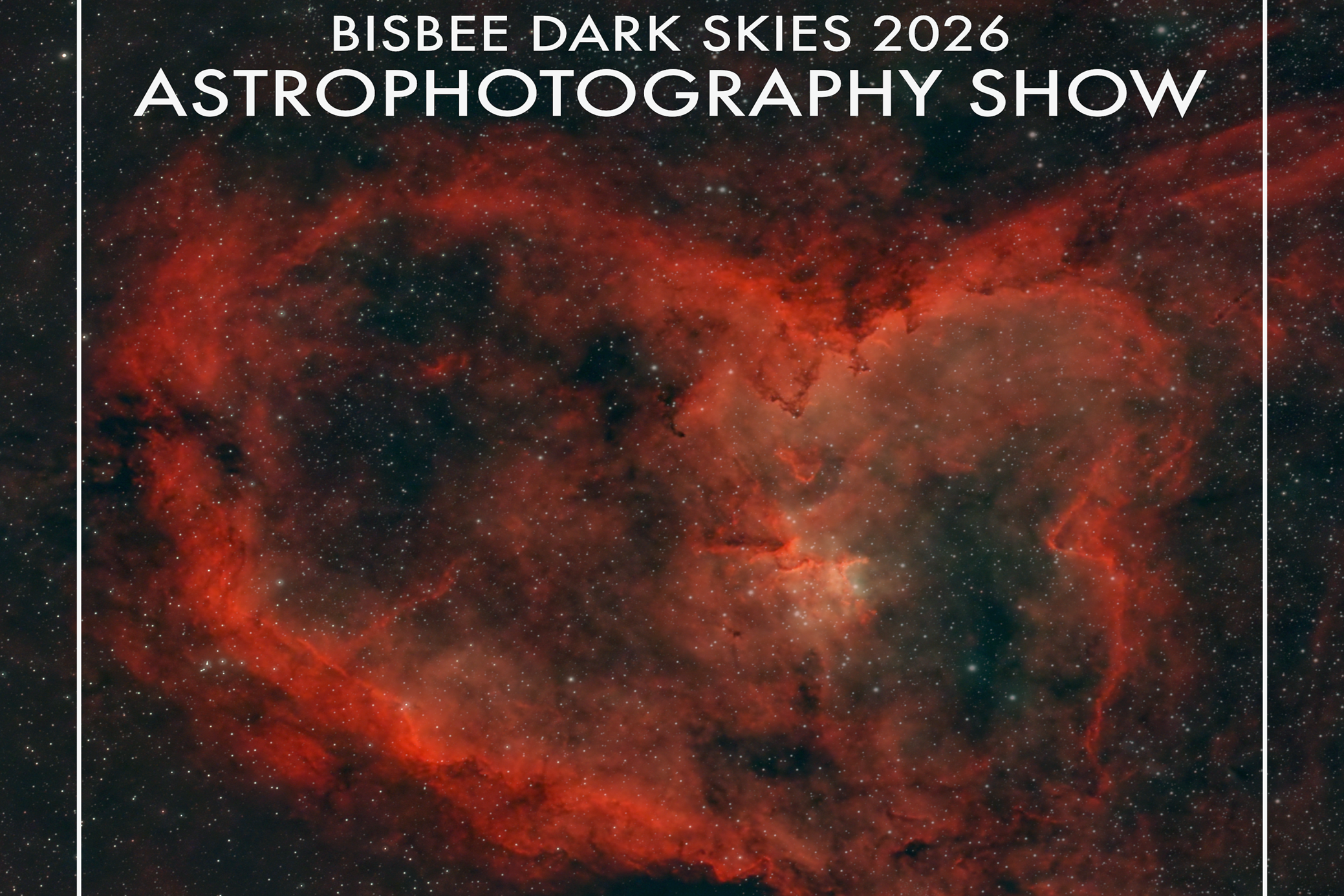
Groundbreaking Art Show Of Astrophotography At Carriage House Studios in Bisbee’s Warren Neighborhood
The Valentine’s Day Art Walk in Bisbee includes something unique and unprecedented this year with the Bisbee Dark Skies Astrophotography Show to be held February 14 – 22 at the Carriage House Gallery (the old Warren Hotel’s buggy barn) at 308 Powell Street in Bisbee.
Hours will be Saturdays 10am to 8pm, Sundays 10am to 6pm. The show will feature works by Robert Gallucci, Steve Pauken and Seven Grey with a mix of terrestrial nightscape and deep space astro-photos. Telescopes will be on hand for Saturday night viewings, as well as the usual wine and snacks. Or if at the Bisbee Community Market in Vista Park, walk on over!

An illusion of tension between science and art still haunts the vestiges of academic power between the arts and sciences, but in Astrophotography the art side of it may have been more of an inconvenience for the powers that be in the arts, than the sciences. And though I could argue that current human science is both an art and a craft, and no more than that (method craft/theory art) the money funding research on the Science side of things is without shamen. So the art of science has generally been hushed up or been socially off-limits to scientific advancement’s loss, no doubt. Scientists, engineers, and technicians were told to specialize and to steer clear of multiple meanings, and multiple identities, not unlike theologians are. Both it seems have a weakness for literal interpretations of a universe, and a humankind, that is figurative and located in our bodies on a planet with gravity forming the illusion of up and down, heaven and hell, and other vertical and horizontal conceptual metaphors. A cognitive regiment where two identities mean opposites, the binary, or ones and zeros, or God and the devil, or you’re either an astronomer or an artist of photography, not both! And by the way, if you do stray into other pursuits, they are hobbies and no matter how many thousands of hours, dollars and dreams you channel into them, “they will never be more than hobbies!” Well, that bullshit doesn’t fly in Bisbee, and it actually never was true in science’s attempts to “see,” document, test and conceptualize nature from nano-particles to the infinite cosmos. The collaborative spirit of Bisbee seems to require a cross-partisan disobedience of falsely-normalized allegiances, sciency dog-whistles, or art world elitism.

Gulf Of The Milky Way, shot in Lowell Bisbee by Robert Gallucci, founder of RGallucci Workshops
To observe our universe has always been a creative action, and has always required creative mediation to filter the noise, separate the particles, and basically hunt like an artist. Partly the only reason that science wasn’t perceived as an art (besides chasing the buck) was the way “subjects” were colonized into specialization. In the case of art that it could only be “realism” or “representational” for a post-aboriginal age. And if you want to spot a fascist, they still push realism-only to this day. But in truth, for what it’s worth, there is no real realism beyond the trope of its rhetorical distinction. So the ambiguities of nature were always codified in an absolute and specialized way (until the next “scientific revolution” quietly structured new functional contraventions over that past.) We pretended that there was a “reality” that we could “know” with our senses, if we could only theorize with “pure reason,” or the “literal truth” while on the sly we invented creative tools and art-materials like microscopes, telescopes, books, paints and film emulsions, always yearning to finally perceive that universe a little more accurately, yet never reaching an absolute touch to the skin of our apperception. These trends still hold true to some extent, or inform the conventions behind us, but the perseverance of modern art and a kind of community-based individualism of liberty have freed “the little guy” from not just the errant pack, but from the hegemony of official top-down institutions in all fields of inquiry, from college town to urban ghetto art scene to the rural art town of Bisbee. The distinctions, the guilt trips, the social asceticism no longer shackle the people actually doing the work.
e or in the module Content settings. You can also style every aspect of this content in the module Design settings and even apply custom CSS to this text in the module Advanced settings.

The Geminid meteor shower peaked December 14, 2026, with the best viewing around 2 AM in Lowell when the constellation Gemini (the radiant) offered up 120+ meteors from the asteroid 3200 Phaethon.
The Artists
In today’s age the artist/astronomer should be able to overcome the predicaments of specialization, the mono-identity of a profession, the split-identity of a trade’s equivalent, enjoying the empowerment of cross-disciplines between career stereotypes and the self-expression of so-called hobbies rolled into one dynamic creative life. The power of a whole self reaching both artistic and empirical, business, and political mastery doesn’t have to be split by control-models institutionaly imposed on us. We can be strong in our viewing of phenomenological artworks as portals to the cosmos. It’s something that fits a Bisbee consciousness rolled up into the present, and what is suddenly presented, as will be at this show.

The M 66 Group Of Galaxies, by Steve Pauken.
This image is the M 66 Group, one of the images Steve Pauken submitted to the show. The galaxies in the group are NGC 3628 upper left, resembling a falling hamburger; M 65 at lower right, and M 66 at upper right. “All of them are within each other’s gravitational influence, and are all spiral galaxies. They are approximately 35 million light years from earth, and are in the region of the constellation Leo. Each of these galaxies were discovered in the 1780’s, and with modern equipment is one of the easiest astronomical objects to find in the night sky. The beauty of this group is that all three galaxies can be seen within the field of view of most telescopes, and the steep angles of presentation allow us to see a view of spiral galaxies that we don’t often see. Because of their location in the Universe, this group is also known as the Leo Triplet. I started doing astrophotography in 2013 and have captured several renditions of the M 66 Group over the years. This one was captured in 2020 in my backyard in Bisbee.” – Steve Pauken, who retiring from being Bisbee’s city manager will hopefully have more time for art!
Steve Pauken is one of Bisbee’s local astrophotographers, and owns his own small observatory. Recently he captured Comet C/2025 A6, the Lemmon, from his backyard telescope. Bisbee Dark Skies featured this on their Facebook page, and it’s because of Bisbee’s increasingly darks skies that make astrophotography like this a possibility. The Comet Lemmon later neared the Big Dipper in the Northern Hemisphere, while Comet SWAN passed across Bisbee’s western sky after sunset. People in the San Jose area near Safeway would have been able to see Comet SWAN because it was low on the western horizon. Did someone make it over there to capture it? Maybe on Saturday we’ll find out.
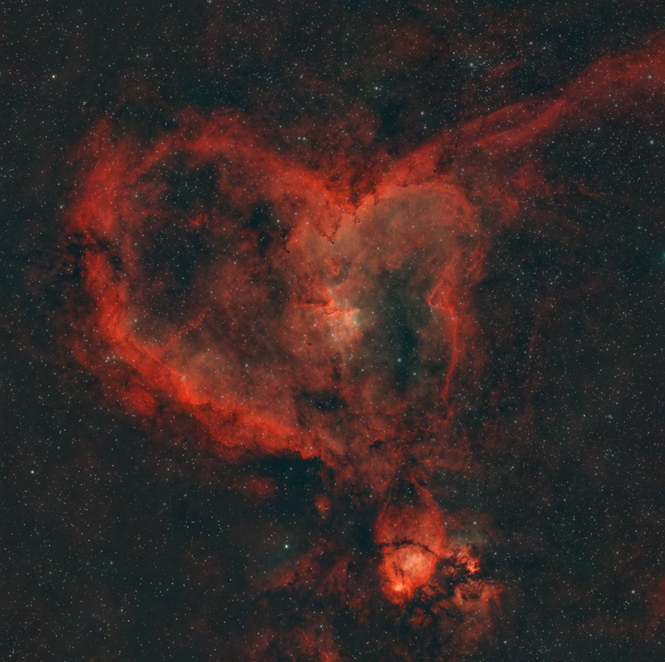
The Heart Nebula (IC1805,) by Seven Grey
This coincidental galaxy image comes just in time for the Bisbee Valentine’s Day Art Walk, and Bisbee Dark Skies 2026 Astrophotography art reception. Seven Grey is a talented world traveler in addition to being an astrophotographer with thousands of subscribers to his travel videologs, recently tracking down a Bisbee UFO, in his latest Vlog.
You can explore his nomadic series, other travel blogs & vlogs, and the other adventures of Seven Grey by clicking the underlined designations below:
Seven Wanders the World Nomadic Home Tours Instagram his personal blog, and you can find Seven’s prolific output of astrophotography on the Bisbee Dark Skies Facebook page.

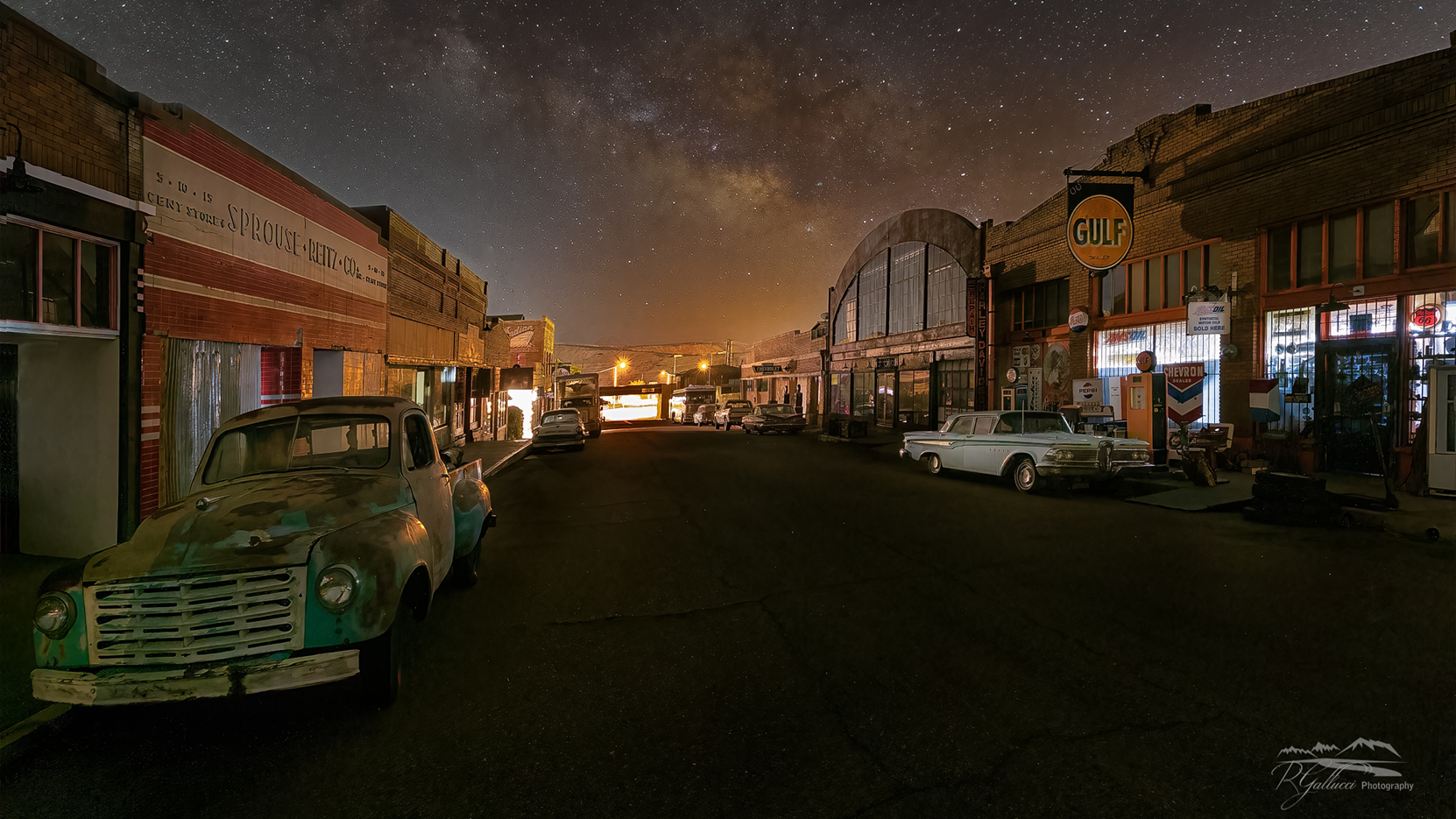
Erie Milky Way Flying Saucer Skyscape, by Robert Gallucci (Lacking file names, I made up fake ones)
RGallucci’s Photography Workshops are conducted by Robert and his team all over the world, from New York City to Sanibel Island, with some Storm Chasing thrown in for good measure. But it’s his Erie Street Astrophotography Workshop which takes place on the Lowell strip of Bisbee that is most in demand by other respected photographers from all over the world. This is a plus for Bisbee as it becomes more known in film circles for her Magical Bisbee Westerns, as I’ve covered here in my Strange Beauty blog before. The juxtaposition of terrestrial and extraterrestrial nightscape imagery entrances those who come here in the middle of the night, an indigo gravity from the deep Lavender Pit pulling its malachite energy up into the ghost cars and structures, and into our visitors cameras and telescopes. At first I thought the constant swirls of selfies on Erie Street was just hovering at a base level of nostalgia. I see now something deeper is going on, day or night; a synchronicity intersection.
“There are a lot of places you can photograph the night sky. There is only one Erie Street. This small stretch of historic storefronts, vintage signs, and classic architecture sits on the outskirts of Bisbee, Arizona, now recognized as an International Dark Sky Community. That means darker skies, better stars, and Milky Way arcs that rise above a cinematic old west mining town.” Robert Gallucci
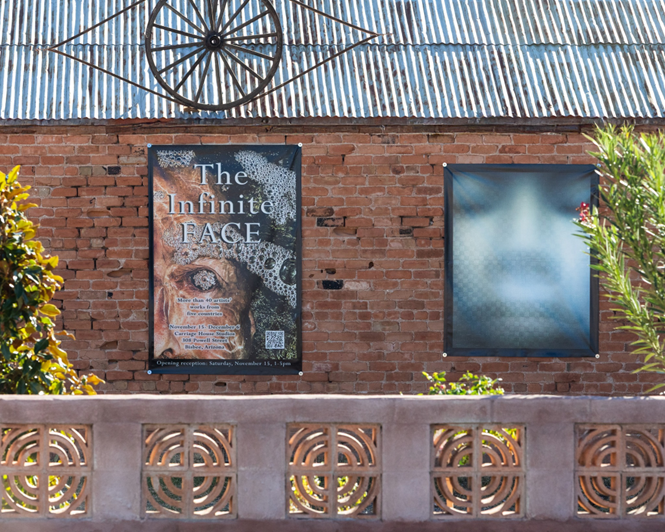
The Bisbee Carriage House, 308 Powell Street Bisbee, behind its old master the Warren Hotel.
The Carriage House gallery and workspace is the brainchild and hard labor of part-time Bisbee artist and stone mason David Neufeld, who having built the gallery first as a work space (maybe to have occasional open-studio pop-up art shows, but…) Once his grand opening happened, he quickly discovered “unexpected artistic pursuits” in the greater Bisbee community to be “arriving in the form of contributions, interest, and especially, other artists wanting to use the space to show work.” And this left David very excited, with a Bisbee Fibre Arts Guild Exhibition coming up next on February 28th, also an all-day Art Reception. Curators are excited at the prospect of visitors walking over from Saturday’s 9-1pm Bisbee Community Market in Warren’s Vista Park. But evening hours for an art reception is always a certain kind of magic, including telescopes that guests will be instructed to use after dark at the Dark Skies Astrophotography show on Saturday February 14th and 21st.
The Bisbee Dark Skies 2026 Astrophotography Show is of course under the auspices of the Bisbee Dark Skies initiative at great effort by Bruce Syrett who had so much to do with this show. One artist referred to Bruce as the curator, but they are all too humble to take credit. I should also mention long time Bisbee arts advocate Sharon Stetter, who is helping to hang the exhibit. I also want to give credit to the Bisbee Dark Sky Business Alliance, “a collection of local businesses that have made the effort to adjust or install shielded lighting on all of their outside areas.” Dark Skies encourages folks to patronize these dark alliance businesses: Poco Market; Thuy’s Noodle House; High Desert Market; Legion Bar and Grill; Artemizia Foundation; Safeway; Copper Queen Hospital; B Active Bisbee; Main St. Bistro; Pioneer Title; Screaming Banshee Pizza; and now the Bisbee Brewing Company.

Erie Star Light Bridge Of The Milky Way, by Robert Gallucci
I will also get into some interesting things about dark skies, a phenomenon of natural life on Planet Earth in all its forms that “light pollution” crosses over, though this doesn’t cross everyone’s minds in a positive way. Our mythology is filled with darkness of a frightening kind, and danger does seem to sometimes live there, along with its metaphors. So also are dark songs often the most beautiful. It’s that juxtaposition between the atonal and a melodic pull at our heart strings, yet with hair standing up on the back of our necks. Photography is a very ancient art form when we dip into its sources. Its chambers below the mount. The holograph from other dimensions teasing at a greater form at night in our sleep.
Like a simile the development of photography began like an astrophotography: “Nicéphore Nièpce would become the Frenchman to fix his name in the history books when he came up with a method to not only capture images but keep them permanently. His method was known as heliograph photography, and it used a pewter plate coated in bitumen combined with light from the sun (and an exposure time of several days). Just like that, in 1822, the world had its first photograph. The view from Nièpce’s window is the earliest surviving photograph we have, and it represents a major leap in technology. About 10 years later, Louis Daguerre, Nièpce’s partner in the development of photography, made a breakthrough. By adding iodine vapor to silver-coated copper plates and then later exposing it to mercury fumes, he could tease out a better image in less time.”
Analogically before that came “camera obscura” and before that came cave painting using pigment sprays perhaps ritualizing a candle obscura of thought and worship of their own perceived cosmos, I imagine. We must remember that we are imagining in our minds whatever it is that we think we are seeing. So these various chambers — camera obscuras, dark rooms, telescopes/observatories, and the other caverns of our experience, are analogical containers of our mental space. They are to greater or lesser extents what we now call immersive art. Astronomers like Kepler used modified, room-sized camera obscuras for solar observations of sunspots, rather than nighttime astronomy. And daytime astrophotography is also possible, and the first camera set up was called a heliograph.
Swing Wide Sweet Chariots Of The Mind, by Robert Galucci
Building-sized pin-hole cameras, essentially large high-aperture camera obscura setups could capture the Moon, possibly planets, serving as a kind of primitive analog to telescope astrophotography. Large sheets of emulsion-painted paper or fabric could be photographically exposed and developed, creating bold tactile artworks. At Art Farm Iowa where I held an artist residency in 2024, the artist Willie Ray Parish had converted a vintage trailer into a camera obscura, completing the circle between observation and emersion. Though for daylight views of the inverted landscape, one could imagine a dark sky version where the trailer is essentially the observatory. This is not to mention the use of manipulated energy technologies to be someday applied to art. Harvard University’s Griffith Observatory features a modern high-resolution periscope-style camera obscura. Santa Monica, California’s Camera Obscura imagines an historic 19th-century attraction, and you can order do-it-yourself cardboard kits from AstroMedia. Bisbee shops might find niche markets among similar offerings. That would probably also feed local scientific and artistic experimentation. Plus STEAM projects at secondary schools, the Copper Queen Library Annex and the Bisbee Science Lab (both already active with the Dark Skies initiative), and the MAKE festival at the Central School Project where future Astrophotography exhibitions are being considered.
In a discussion yesterday while asking about using pin-hole cameras for more experimental astrophotography, local photographer, astronomer and political cartoonist Tom Appleton mentioned that our late friend Winston Fredrickson, a very young artist, recent physics and modern languages graduate, and brewmaster at his family’s Electric Brewing company in the San Jose neighborhood of Bisbee, had indeed made and used a pin hole camera for astrophotography. Above the brewery “He took pictures of the sun from a pin hole camera he made from an aluminum can he mounted to the roof” his mom Natalie later told me. He used cyanotype, and “primarily tracked the sun. He might have made an analemma as well, using a pinhole apparatus.” wrote Tom Appleton to me. It’s likely Winston would have become one of our more experimental artist astrophotographers had he not mysteriously died in his sleep. I wonder what I missed and how I might have collaborated with him, and now must do so with someone. But besides being a visual artist, I’m also a poet. Then Natalie said to me “In school he wrote poetry about black holes and things…” and I had to see some of these poems. Since ultimately even photography and “the real” are in our minds, we almost have to consider that astrophotography could leave the frame altogether and include other genre’s like poetry. Natalie wasn’t able to find the cyanotypes on such short notice, but she found one of Winston’s poems in an email on her late son’s laptop. It might have been eerie receiving the email from the late Winston Fredrick, but it actually was inspiring and healing. And of course I knew it was sent by his mother, his thoughtful sonnet that seems to have influenced some of what I’d already written for this article:
Winston Crockett Fredrickson
Started July, 2018
This version January 28, 2019
Sonnet not for a class.
Moon
A planet hit Earth and took out a bite.
All the Earth’s surface went up in a spray.
Fragments accreted and cooled ’till today
we see cold lava seas and highlands quite bright
and zillions of craters dot everything in sight.
No water or wind erodes it they say
micrometeorites grind the surface away.
Look in the sky, Earth’s shining satellite.
Some see a rabbit, and some see a face.
What could it be, thought people everywhere
that can block the Sun and controls the tide?
A mirror? A shell? A god or a place?
Might we visit it? Are there people there?
Look for yourself, it’s probably outside.
My interpretation of Winston’s poem is how humans interpret the universe through the totem animals and forms found on earth largely due to a proto-planet hitting the proto-Earth. This created the Moon (the Giant Impact Hypothesis) yet also led to ours and these other animals and forms here on Earth. Yet a loneliness of our barren moon reflects on us but that we may imagine for it also from these forms.
Reality is never what it seems to us humans, bound to our senses that both filter and interpret reality for us in our imaginations which have ultimately spawned memory and intellect and tools to a point of creating shared reality interpretations, whether you call them charts, tests, photos, or a collective unconsious. In astrophotography there are something called gradients. They are the levels of what in an urban context we might call light pollution, but their sourcing also include natural light-giving, or reflecting bodies throughout the cosmos, from galaxies to stars to moons. Light pollution might make gradients in the telescope or photo unbearable to manipulate(I’m probably not saying this right), but in order to interpret the cosmos with cameras, films, telescopes, or other energy ray devices, we must soften, or reorganize, or otherwise manipulate gradient light distortion of what we are trying to focus on, and “see” what it is we want to capture, or the allure of something not yet discovered. Now there are of course Artificial Intelligence tools for removing gradients. AI tools have a “losing human control” danger that they might surreptitiously fictionalize data, unknown to it’s users. But the misperception of actual reality has always been stock and trade to science, and its craft, I would argue. It’s not so much a bad thing because as a fallibility it may also be the canvas of life itself. Of that reality itself. “The controversy revolves around… the potential for data fabrication, and the implications for scientific accuracy…” and “the balance between automation and artistic control,” says the lucrative marketplace of a highly technical industry. (This commercialization is also a feature of traditional art supplies.) So I think the issue of “artistic control” is a matter for serious artists to do whatever they want to with it because an inexact perception of “the real” has always been with us. It’s often artists who are the ones at the cutting edge of discovering the edges of our institutionalized illusions.
I suspect, and will continue writing as if, that we conjure truth subjectively, even through scientific instruments, the craft of the scientific method, and our very senses using those extensions. There’s no interest in some dog whistle “relativism.” It’s as plain as The Heisenberg Uncertainty Principle all day long. All of “reality” and “truth” is interpreted, filtered, projected, and imagined, no matter how close or exact our narrative of measurement, and no matter how “literal” the “data,” that data bolted into the figurative foundation of our experience. Our bodily lived experience as humans being the sourcing of the entirety of our knowledge and cognitive wherewithal. A linguistic model like this has been largely influential since Lakoff and Johnson’s Metaphors We Live By in 1980, and our AI large language models have been trained on those models of cognitive metaphor, too, so we’re not out of the woods by using AI. There are prolific advances to astrophotography using AI tools, but they echo our disposition.
I believe that it will ultimately be, maybe always has been, the artist-scientist who advances the edges of any such progress; the artist’s “avant-garde”, breaking through the structure of our false-duality of separating the scientific from the artistic, the intellect from the imagination, and ironically, by finely tuning our emotional intelligence with our scientific instruments. But human consciousness is a larger entity, and study, and may reveal some very deep tools from beyond the blood-brain barrier of the assumed self. That it is more the Artist’s lived domain, while more the Scientist’s observed domain. Put together, a true poem is written measuring from behind the primordial scream of the soul, or the Milky Way, both being too close and too far away. So the quiet and steady emergence of astrophotography, first as a technical tool for helping us to imagine and “see;” to measure and catalog the cosmos, and to test what is out there that we otherwise actually can’t “prove” has crept into its current position as a genre of contemporary art (or I advise it to.) Because it is by the nature of art for art’s sake’s reach — that it may be assumed that the arts contain an identity and definition of its own science, or is about to. This open’s an important gateway for the larger science community identity to empower its own peripatetic social paradigm to include the contemporary artist identity as its own. And then to get down to work.
I recommend that even conservative astrophotographers, and other tinkerers of the metals, make a bold declaration of their entrance into the contemporary art world, and that they do so on their own terms, should they see to find their own terms. Though many may be considered hobbyists, the commitment of time, effort, learning and resources engenders the discipline of a comparably “professional” artist, inventor, or scientist. With years behind the wheel, the barrier of naivety is scraped from the palette. Meanwhile, Cochise College/UofA and Bisbee have become the perfect launch pad for a new art and science movement of Astrophotography to both take root, and take off. An experimental aptitude for playing with our ideas and tools should be encouraged. Collaboration between the Physics and Astronomy and Art Departments do, at least in rumor, seem to be in courtship. Pop-up astronomy workshops throughout the county could develop into simultaneous pop-up art show happenings where their eventual similitude of subject experimentation cross-fertilize. So this art show by three local and dedicated astrophotographers, hastily organized when the opportunity became apparent, is in all probability the beginning of a much greater development in Bisbee.
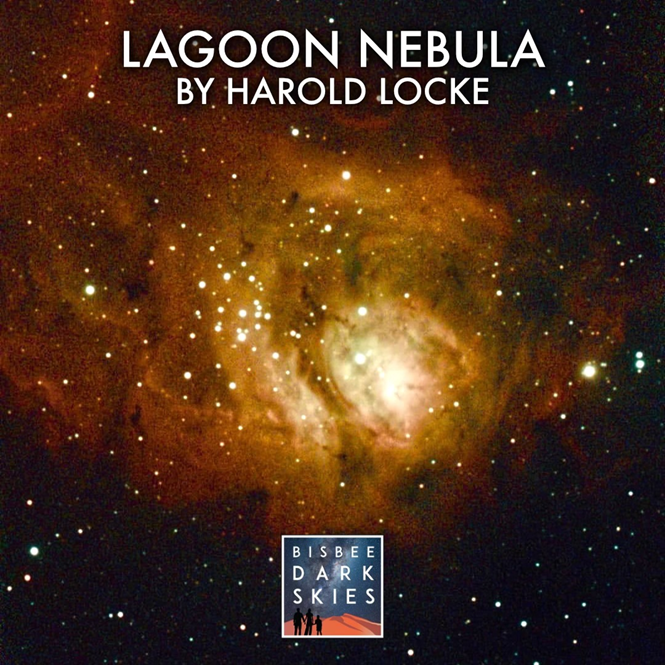
By Harold Locke, a Bisbee resident, “one of several astrophotographers who are passionate about capturing photos of deep space objects like nebulae, galaxies, and other distant objects.” Not in the current show, but featured in this Bisbee Dark Skies poster.
Ken Boe is a Bisbee artist and writer. You can support his work at patreon.com/kenboe including his Poem At Night series, his new blogs and videos, and his newly resumed Bisbee Poetry Normalization Project. #BPNP infamously normalizes in small surprises in sudden places a presence of poetry all over Bisbee, and now in other towns like Northwood Iowa where Ken Boe enjoyed a residency at Art Farm Iowa. Find a poem on an old telephone pole or a shop window or a bulletin board, just like you might find posters announcing Bisbee’s local music and art shows. You may see where to get his artwork locally, or other projects, at kenboe.com.