
Has anyone not heard of Bill Mead?
If you’ve lived in Bisbee for any amount of time, you’ve seen at least one of his more than ten public murals scattered from Old Bisbee to Warren, not to mention the additional works tucked away on private homes and retaining walls. His images seem to appear when you least expect them; a burst of color on a stair-stepped alley, a dream unfolding across a sunbaked wall. They stop you mid-stride.
For those not yet in the know, here’s the not-so-secret truth: Bill Mead is one of the most prolific Surrealists you’ll ever encounter. His work places “real things in unreal places, or real things out of place,” as he puts it, and the result is both disorienting and oddly comforting. Familiar objects float, stretch, hover, or loom against landscapes that feel like they exist just one dimension over from our own.
When I asked Bill when he first started painting, his answer came with a touch of humor and humility. He noticed he had a knack for drawing around the age of 13 or 14. But the pull toward art started even earlier. “I was very much drawn to drawing as a wee-tot,” he told me. His paternal grandmother was an artist who taught at the Boston School of Fine Arts during the Great Depression. He suspects he may have inherited some of her ability.
His style is unapologetically surreal. When asked to describe it, he keeps it simple: “Surrealism. Real things in unreal places or real things out of place.” But behind that clean definition lies a thoughtful and almost architectural approach to composition.
When I asked what influences the characters he paints, he paused to clarify the question. If I meant who influenced him, he immediately cited Hieronymus Bosch and René Magritte as his favorites. Both artists are known for bending reality into dreamlike allegories, so the connection makes perfect sense.
But what influences his characters, that’s where it gets interesting.
For Bill, it all boils down to shape, color, and balance. “I paint what I find to be pleasing to the eye,” he explained. The characters in his work aren’t simply whimsical; they fulfill compositional needs. A tomato offers a perfect round red form. An alligator provides a dark, elongated, textured shape. Instead of painting abstract blocks of color, he uses fruits, animals, and landscapes to achieve the same visual harmony.
And yet, there’s more beneath the surface.
On a deeper level, those objects carry symbolism. Fruits represent sustenance. Landscapes suggest home. What might first read as playful surrealism quietly carries emotional weight, such as nourishment, belonging, and stability. In a town like Bisbee, where landscape and identity are tightly woven together, that symbolism feels especially resonant.
Bill has been a professional artist for about 20 years. He marks the beginning of that chapter with a phrase that’s both candid and revealing: “Ever since I put the plug in the jug.” Before that, he says, he was “living in the dark ages.” There’s no elaboration needed. His art became a turning point.
Born “at a very young age,” as he jokes, at Camp Lejeune in Jacksonville, North Carolina, Bill was a Navy brat. Though he’s lived most of his life in South Carolina, particularly Lady’s Island and the surrounding area, Bisbee has clearly embraced him, and he has embraced it in return. His murals feel integrated into the town’s personality, as though they’ve always been here.
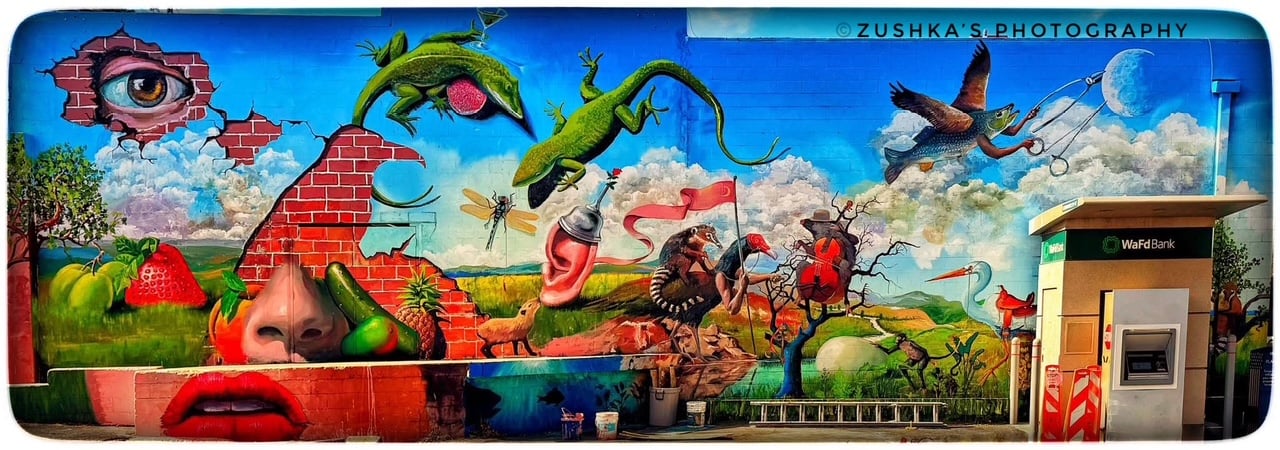
His most recent large-scale mural in Old Bisbee, titled “Leonardo the Lizard,” came to fruition through collaboration. According to Bill, it was a collective effort aimed at bringing more public art to the community. Sloane Bouchever, Allison Williams, and others helped make it possible.
“Leonardo the Lizard” is monumental, playful, and unmistakably Mead. Like much of his work, it transforms an ordinary wall into a portal. It’s public art in the truest sense – accessible, unexpected, and alive in the shared space of the town.
What strikes me most about Bill isn’t just the scale of his output, but the consistency of his vision. There’s no chasing trends here. No performative complexity. Just a steady dedication to shape, color, balance, and the quiet poetry of placing things where they don’t quite belong.
In Bisbee, where art spills into the streets and creativity is stitched into the hillsides, Bill Mead’s surreal worlds feel right at home, even when they’re intentionally out of place.
There is a lot to take in at first glance of Leonardo the Lizard! The first thing that hit me was the movement. That electric-green lizard isn’t just crawling, he’s launching himself across the sky, suspended mid-leap like he owns the atmosphere. The pink of his mouth pops against the saturated blue background, and suddenly, you realize Bill isn’t just painting animals, he’s orchestrating color.
And then your eye starts traveling.
A cracked brick wall reveals a hyper-realistic eye peering through. A disembodied ear floats nearby. Lips rest at the base of a half-demolished face. Strawberries, peppers, and pineapple spill into the scene like offerings. A dragonfly hovers. An alligator’s dark, textured body anchors the lower right. In the distance, soft clouds roll beneath a pale moon.
It’s exactly what Bill described: real things in unreal places.
But standing back and looking at it as a whole, you can see what he meant about shape and balance. The round red strawberry mirrors the curve of the lips. The long green body of the lizard echoes the sprawl of the landscape. A darker form, like the twisted tree, counterbalances the bright sky. Even the fragments of the face create geometric tension against the organic shapes.
In this mural, home feels expansive. Wide fields. Open sky. Air. It’s not cramped or chaotic, even with all the surreal elements. There’s breathing room.
What I love most is how the mural interacts with its real-world surroundings. To the right, tucked almost humorously into the composition, is the ATM of WaFd Bank. There’s something very Bisbee about that. High-concept surrealism exists right alongside everyday practicality. You can withdraw cash and then look up into a dreamscape.
The scale matters too. At approximately 80 feet wide and about 20 feet tall, this isn’t something you glance at. It demands you stop. It invites you to wander through it visually the same way you wander through Old Bisbee’s streets.
And honestly? It feels playful!
For all the compositional theory and art history lineage, like the nods to Bosch and Magritte, there’s still a sense that Bill is enjoying himself. The lizard feels mischievous. The floating ear almost makes you laugh. The cracked-wall illusion is bold and theatrical.
It’s public art in the best sense: accessible, layered, and impossible to ignore.
Seeing the mural this way adds another dimension to the article. It shows not just Bill’s philosophy, but his confidence. This isn’t tentative surrealism tucked inside a gallery. It’s 1600 square feet of imagination, unapologetically placed at the entrance of town.
Leonardo doesn’t just sit on that wall. He owns it.
And in true Bill Mead fashion, he reminds us that in Bisbee, even the walls have dreams. And if we’re paying attention, they just might invite us to leap a little further ourselves. Thank you, Bill!